

When Is Hospice Care Appropriate?
When you care for someone living with advanced illness, and they continue to live while declining, there often comes a point where your next question is: “when is hospice care appropriate?” The technically correct answer is this: hospice becomes appropriate when a physician certifies that your person’s illness is terminal—meaning they likely have 6 months or less to live and there is no longer a path toward cure.
But here’s the problem. Even though that definition is technically clear, the reality of dying in the real world is not.
Dying Takes Longer Than You Think
Most people don’t have experience with many deaths the way hospice professionals do. They don’t know that dying often takes much longer than anyone expects.
And most dying happens off hospice, not on it.
Most dying is illness-related, yet only about half of people ever receive hospice, and many of those who do are only on it for the final 14 days of life. But the dying time often begins long before that.
As a hospice nurse with 15 years of experience, I can tell you this clearly: the dying time is longer than most people think. When people say, “she turned the corner,” they are often talking about what they believe is the final stretch.
In reality, that “corner” is often a month, two months, sometimes longer—not just the last two weeks.
And here’s what makes this so hard: we cannot reliably predict how long someone has.
Some people stabilize. Some decline quickly. Many decline slowly. But most suffering happens in the space where dying is already underway—and no one is acknowledging it.
5 Stage Timeline
I created a simple 5-stage timeline to help make sense of this period—from when treatments begin to stop working through death.
Because this is where most people are living. And most of this time happens before hospice is ever involved. And the advanced illness time period can be the time period of greatest suffering.
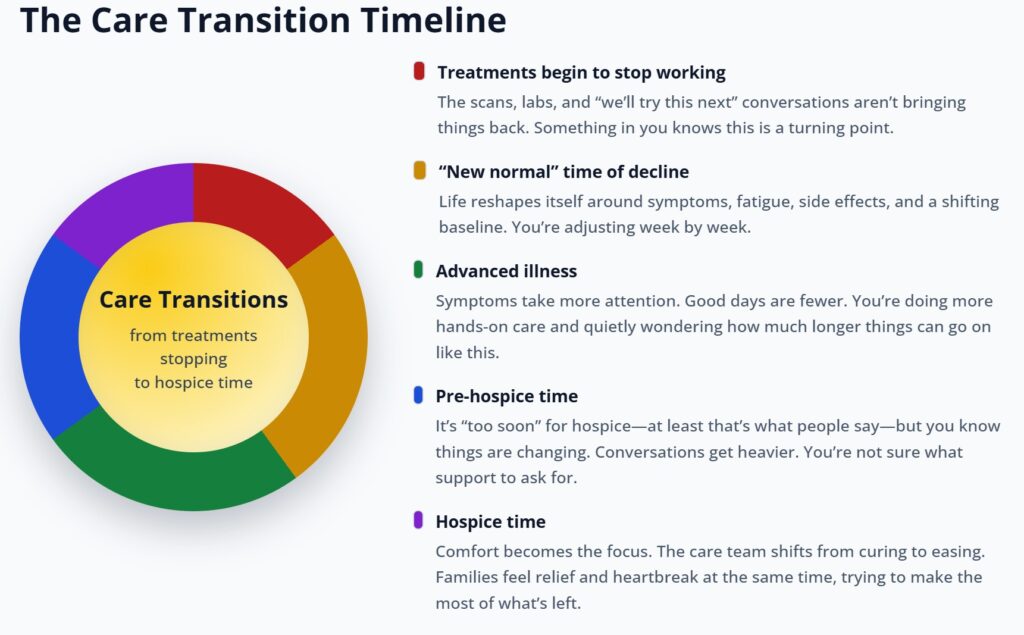
Now, it’s true, some people move quickly through these stages. Others stay in one stage for a long time.
The truth is, we will only know in hindsight when someone’s last year of life actually was.
And that uncertainty is exactly why so many people suffer. Because they don’t realize they’ve already entered a different timeline.
If your person is living well with advanced illness, there is no issue.
But what if they are not?
The Gap Between Treatments for Cure and Hospice
We have seen this gap firsthand …it’s huge! It’s the responsible care that resides between cure-focused care and hospice. Right now there is a chasm that is very wide.
We’ve watched people we love suffer. And after they die, many of us carry guilt, wondering if we should have done something differently.
As families, we depend on healthcare to handle the entire situation. But what we all know is true (families and pros alike) is that unfortunately, with advanced illness and end of life situations, so often families must advocate for themselves and change what’s going on if they don’t like it.
And there is a path most families are not shown…it is where curative and comfort treatments meet. That path is called Palliative Care. You do not have to wait for hospice to begin focusing on comfort.
The advanced illness time period is so hard because no one can give us a definitive timeline. Families are often told, “it could be months… it could be longer.”
So they wait. And by the time it is clear, it’s too late to have prevented the suffering they have already endured.
Last Chapter Mindset
So, instead of waiting for certainty, I suggest something different. If you recognize your situation somewhere in this timeline, treat this time as meaningful now.
Adopt what I call the Last Chapter Mindset.
When you are in the messy middle of transitions let the Last Chapter Mindset guide you. Assuming it’s grandpa we are caring for, the Last Chapter Mindset is a commitment to keep grandpa comfortable by assuming he is in his last year of life even though we have no idea if he is or not.
Let this positioning guide every decision on a daily basis. There is nothing to lose but suffering.
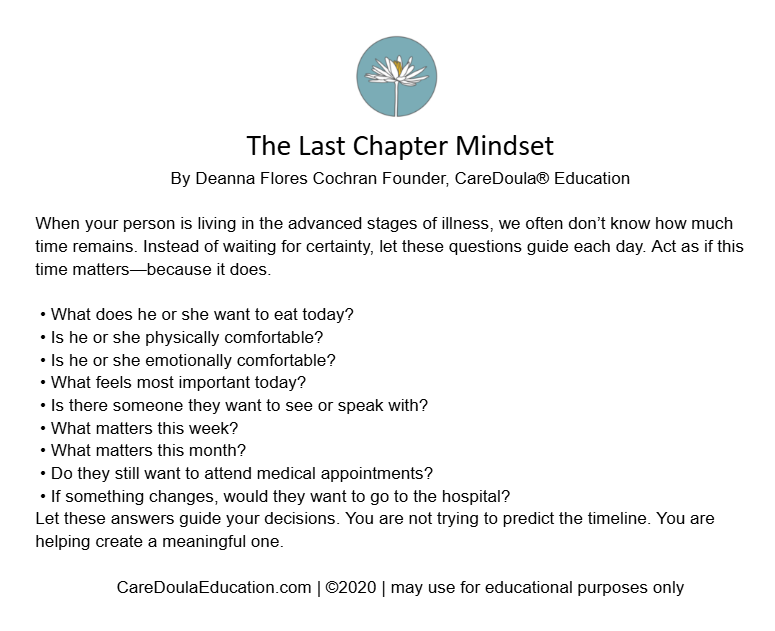
The Last Chapter Mindset is simply questions like:
- What does he want to eat today?
- Is he physically comfortable?
- Is he emotionally comfortable?
- What is important to him this day?
- Is there anyone he wants to see?
- What are his goals today? This week? This month?
- Does he still want to visit his doctors in their office?
- Does he want to the hospital the next time ‘something happens?
And if we let these questions be our guide, then questions 7 and 8 most likely will be what guides the answer to, “is it time for hospice care right now?”
If we are wrong, and grandpa is alive after a year, we celebrate another year! But what if we are right? What If it was his last year of life? Then we know it will have been a good one.
Because of all I described above, I believe in the Last Chapter Mindset approach of “acting as if” even though we don’t know.
Studies That Support The Last Chapter Mindset.
If this feels intuitive, there’s also strong evidence behind what I’m saying. Below, I will leave you with 10 studies I gathered that support my biggest reasons to initiate the Last Chapter Mindset, when our person is in the advanced illness stages.
- Reason 1: Clinicians are systemically over-optimistic about survival, so “wait until we’re sure” is structurally unsafe. 63% over-optimistic.
Study: Palliative Care Clinician Overestimation of Survival in Advanced Cancer: Disparities and Association With End-of-Life Care. - Reason 2: The median hospice experience is weeks, not months—so “we’ll start comfort care when hospice starts” is mathematically too late for many. Median hospice length of stay for Medicare decedents is ~18 days.
Report: Medpac. Medicare Payment Advisory Commission. March 2026. Chapter 9. - Reason 3: Hospitals and ICU are still the default in the last 90 and 30 days—meaning suffering and decisions happen under crisis conditions if you don’t pre-plan. Among Medicare fee-for-service decedents in 2015, 65.2% were hospitalized in the last 90 days.
Study: Resource use in the last 6 months of life among Medicare beneficiaries with heart failure, 2000-2007 - Reason 4: “Burdensome care” near death isn’t rare; it shows up as transitions and invasive interventions that are difficult to reverse at the last minute.
Study: Site of Death, Place of Care, and Health Care Transitions Among US Medicare Beneficiaries, 2000-2015 - Reason 5: Symptom burden rises months before death, not just in the final days—so waiting for a clear terminal label misses the actual suffering window.
Study: A comparison of symptom prevalence in far advanced cancer, AIDS, heart disease, chronic obstructive pulmonary disease and renal disease - Reason 6: Loss of reliable patient self-report and decision-making capacity is common near the end—so “we’ll decide later” is often not an option.
Study: Restricting Symptoms in the Last Year of Life, A Prospective Cohort Study - Reason 7: Some “advanced illness” states already carry high near-term mortality and frequent complications—so it’s rational to behave as if time is limited even when the exact countdown is unknown.
Study: Early Palliative Care for Patients with Metastatic Non–Small-Cell Lung Cancer - Reason 8: Family caregiver burden is a predictable casualty of late transitions, and it is measurable.
Study: Caregiver’s burden at the end of life of their loved one: insights from a longitudinal qualitative study among working family caregivers - Reason 9: Late hospice referral is associated with worse family experience and unmet needs—so “we can always call hospice later” is not a neutral choice.
Study: Late Referral to Hospice and Bereaved Family Member Perception of Quality of End-of-Life Care - Reason 10: “Acting early” has evidence of benefit—and does not inherently shorten life. Early integrated palliative care in metastatic lung cancer improved quality of life and mood, reduced aggressive end-of-life care, and in that trial was associated with longer median survival (11.6 vs 8.9 months).
Study: Early Palliative Care for Patients with Metastatic Non–Small-Cell Lung Cancer
You can download your copy of the Last Chapter Mindset questions below.
Do you want to learn more about this?
For volunteers and professionals: If you are the one people turn to in moments like this…this is the work. If you want to learn how to help people during this time, review our CareDoula® programs here.
For families: If you need to understand your situation better and/or want guidance through it, visit our Family Resources here.
Watch the accompanying “When Is Hospice Care Appropriate” video below.
Below is a rough guide of the contents of the video.
Approximate Minutes:
- 0–2: Navigating the Two Medical Timelines
- 2–4: The Reality and Statistics of Dying
- 4–6: The Five-Stage Timeline of Decline
- 6–8: Palliative Care and the “Last Chapter Mindset”
- 8–10: Prioritizing Quality of Life Now
- 10–12: Identifying the “Opening” for Hospice
- 12–15: Evidence-Based Benefits of Early Enrollment